
Type: heritage-historicalEntrance fee: FreeHours: Monday-Friday, 8:00 AM-5:00 PM (Tourism Office / government hours)
Overview
The Historic Old Panglao Municipal Hall — referred to locally as the Old Municipio — is a two-storey Spanish colonial civic building in Barangay Poblacion, Panglao, Bohol. It has been classified as an Important Cultural Property (ICP) by the National Museum of the Philippines, placing it among the country’s formally recognised built heritage assets.
Constructed in the 1800s during the Spanish colonial period, the building served as Panglao’s primary seat of local government for over a century — through the end of Spanish rule, the American colonial period, and into the early post-independence years — until the municipality established a new municipal hall in the 1960s. Rather than decommission the structure, the local government unit of Panglao adaptively reused it, converting the landmark into a functioning civic and cultural facility.
Today the building houses the Panglao Municipal Tourism Office, including its Culture and the Arts Division — the practical starting point for anyone seeking heritage or cultural information about the municipality. The ground floor also holds public service units, including a Bureau of Immigration satellite office. The second floor is now a local heritage museum, developed with technical assistance from the National Museum of the Philippines.
The Karaang Butang Exhibition
The second floor hosts the “Karaang Butang” (literally: Old Artifacts) exhibition — a permanent curated collection of over 500 verified historical antiquities, vintage domestic objects, and cultural items sourced from private collectors and from each of Panglao’s ten component barangays.
Notable items in the collection include:
- Duwang — centuries-old heirloom wooden basins traditionally used for laundry and bathing infants, representing pre-industrial domestic life in coastal Bohol communities
- Kinkilya — vintage oil and gas lamps that were standard household lighting before electrification reached Panglao
- Charcoal flat irons — heavy cast-iron pressing irons used with live charcoal, a standard domestic tool from the Spanish and American periods through the mid-20th century
- 114-year-old saxophone — originally played by the historical Sapa Orchestra during colonial-era fiesta celebrations of San Sebastian; one of the exhibition’s most significant musical heritage items and a direct material connection to Panglao’s organised musical tradition
Architecture
The building is a classic example of a Spanish colonial tropical civic structure: a robust masonry ground floor designed to resist typhoon winds and flooding, with an upper floor traditionally built from seasoned local hardwoods. The second floor features wide windows for cross-ventilation, characteristic of the Spanish-Philippine hybrid building tradition that governed civic construction in the Visayas through the 19th century. Capiz-shell window elements — a defining material of Philippine colonial interiors — are present in the original fabric.
The structural logic reflects the colonial-era model of placing heavy administrative functions and storage at ground level, with lighter social and ceremonial spaces on the more open upper floor.
Location
Barangay Poblacion, Panglao municipality, Panglao Island, Bohol. The building faces the Panglao Town Plaza — the municipal centre — and is within walking distance of the Panglao Watchtower and San Agustin Church complex, the Archway and Mortuary Chapel of the 19th Century Cemetery, and the Escuelas de Niños y Niñas. The Poblacion heritage cluster is compact and walkable.
Coordinates: approximately 9.5756°N, 123.7459°E (now reflected in the frontmatter — see coordinate note below). [FACT NEEDED: precise GPS coordinates of the building entrance specifically, as opposed to the Poblacion town-centre area.]
Getting There
From Alona Beach: habal-habal or tricycle to Panglao Poblacion, approximately 15 minutes. From Tagbilaran City: jeepney or van to Panglao town centre, approximately 30–40 minutes. The building is at the town centre adjacent to the plaza.
Practical Info
- Panglao Municipal Tourism Office: open Monday–Friday, government office hours (8 AM–5 PM)
- The Karaang Butang museum on the second floor is accessible during office hours — confirm with Tourism Office staff for guided viewing arrangements
- Bureau of Immigration ground-floor office: standard government service hours
- No entrance fee for the Tourism Office. Museum viewing: inquire at the ground-floor Tourism Office counter
- The building functions as the primary information point for cultural tourism in Panglao — staff can arrange or direct visitors to heritage sites across all ten barangays
What to Expect
This is a working government building with an active heritage museum layered on top — the ground floor a standard LGU office environment, the second floor given over to Karaang Butang: 500-plus objects documenting everyday life in Panglao across several centuries, strongest in domestic material culture and musical heritage. The 114-year-old Sapa Orchestra saxophone is the single highest-profile piece.
The building itself doesn’t need the exhibition to read as a heritage object — the staircase, floor planks, window proportions, and masonry walls make that case on their own.
Notes
ICP designation by the National Museum of the Philippines confirms formal heritage status. The adaptive reuse model — Tourism Office plus heritage museum inside a functioning 19th-century civic building — is one of the more successful examples of LGU-led heritage preservation in Bohol Province.
Importance confirmed high on the basis of ICP designation, 500+ artefact collection, and function as the primary cultural tourism gateway for Panglao municipality. Restored after pass 2 workflow overwrite.
[FACT NEEDED: confirmed museum opening hours; whether advance booking is required for guided tours; National Museum ICP registration number — none of these resolved by research.]
Coordinate correction 2026-07-17: frontmatter previously read 9.952009, 123.961825 — a position roughly 45 km northeast of Panglao, in the vicinity of Ubay/Trinidad rather than Panglao Poblacion, and clearly a data error. Replaced with the 9.5756, 123.7459 value already given in this file’s own Location section, which is consistent with the neighbouring heritage-cluster entities (Archway and Mortuary Chapel at 9.5779/123.7454; Panglao Watchtower at 9.5833/123.75; Panglao Town Plaza at 9.5775/123.753).
Explore Panglao: Bohol's Busiest Beach and Dive Municipality
More to see in this area
 municipality
Panglao: Bohol's Busiest Beach and Dive Municipality
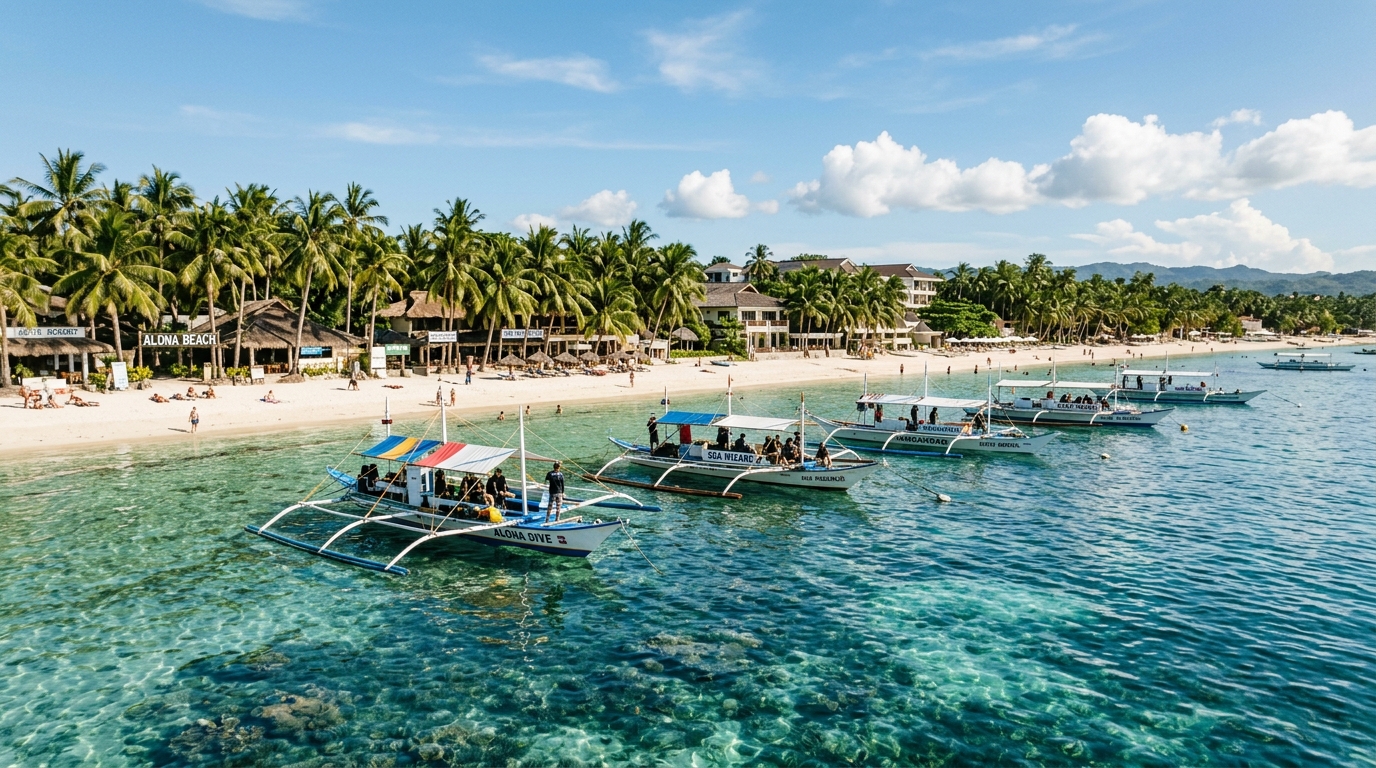
Panglao is the island municipality behind Alona Beach and Bohol's reef diving, joined to the mainland by two bridges and drawing the largest share of the province's foreign tourist arrivals.
Best: Dec–Apr
More attractions in Panglao: Bohol's Busiest Beach and Dive Municipality
Other things to see nearby
Escuelas de Niños y Niñas
In August 2023, the National Museum of the Philippines-Bohol unveiled five heritage markers for important cultural properties in Panglao including the Escuelas de Niños y Niñas. During the American occupation, these were two separate buildings that housed the boys' and girls' schools.
- Alona Beach — Alona Beach is a public beach at the southwest tip of Panglao Island, in Barangay Tawala.
- Alona House Reef — The dive site is famous for its beautiful sloped wall covered with many different species of corals. Its sea beds are mostly sandy with a big formation of corals with colorful tropical fishes swimming around.