
Type: heritage-historical
Overview
The Escuelas de Niños y Niñas (“Schools for Boys and Girls”) are a pair of heritage school buildings in Poblacion, Panglao Island. During the American colonial period, the two buildings operated as separate schools — one for boys (niños) and one for girls (niñas). In August 2023, the National Museum of the Philippines-Bohol unveiled five heritage markers for significant cultural properties in Panglao; the Escuelas de Niños y Niñas were among the five structures recognised.
The buildings stand as a record of early American-era public education policy in the Philippines, when gender-segregated schooling was standard practice.
Location
Poblacion, Panglao, Panglao Island, Bohol. The Panglao town centre (Poblacion) contains a cluster of heritage structures in close proximity — the old cemetery archway, the watch tower, the old municipal building, the Nova Shell Museum, and the Fatima Crusaders’ Chapel (ruins of the old Panglao church). The Escuelas are within this heritage precinct.
Getting There
From Tagbilaran City, Panglao Poblacion is approximately 12 kilometres via the Panglao Bridge road. Tricycles and habal-habal are available from Tagbilaran’s city proper. Within Panglao town, the Poblacion heritage buildings are walkable from each other. [TO ENRICH: specific street address, distance from Alona Beach, tricycle fare from Alona.]
Practical Info
- Municipality: Panglao (Panglao Island)
- Barangay: Poblacion
- Heritage designation: National Museum of the Philippines heritage marker (August 2023)
- Tourism classification: History and Culture — Structures and Buildings (BPTO)
- [TO ENRICH: building condition, whether publicly accessible inside, opening hours if any, guided tour options in the heritage precinct]
What to Expect
American colonial-era school buildings, marked with National Museum heritage plaques, at the start of a short walking circuit that takes in the rest of the Poblacion cluster within a few minutes on foot. The pairing of separate boys’ and girls’ schoolhouses reflects the American colonial government’s public-education push after 1901 — free elementary schooling delivered through a purpose-built structure in nearly every municipality, a break from the more limited, church-run instruction of the Spanish period. The area is quieter than Alona Beach and gives a different perspective on the island’s history beyond its dive and beach profile.
Notes
The five heritage markers unveiled in August 2023 by the National Museum of the Philippines-Bohol cover the most significant cultural properties in Panglao. [TO ENRICH: names of the other four properties marked, architectural style and materials of the Escuelas buildings, conservation challenges given the island’s rapid tourism development.]
Explore Panglao: Bohol's Busiest Beach and Dive Municipality
More to see in this area
 municipality
Panglao: Bohol's Busiest Beach and Dive Municipality
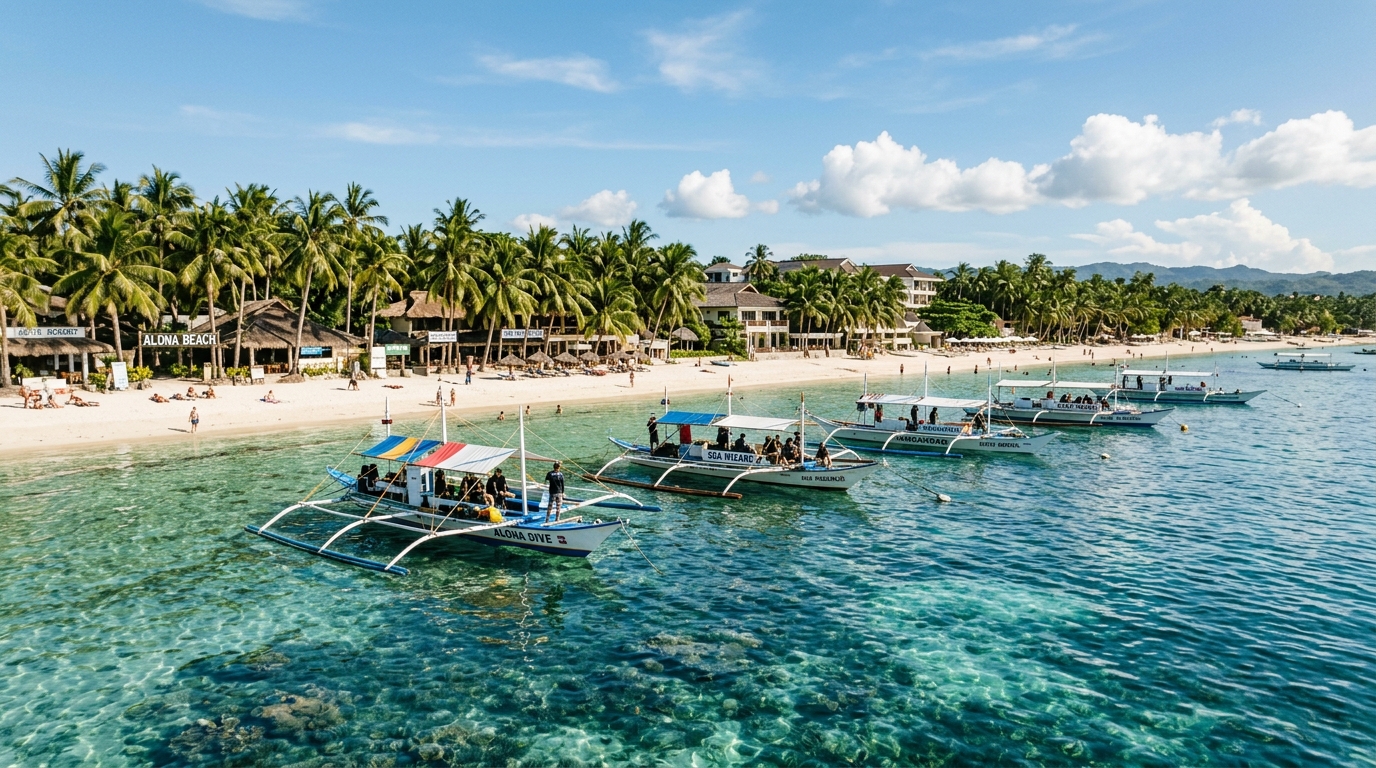
Panglao is the island municipality behind Alona Beach and Bohol's reef diving, joined to the mainland by two bridges and drawing the largest share of the province's foreign tourist arrivals.
Best: Dec–Apr
More attractions in Panglao: Bohol's Busiest Beach and Dive Municipality
Other things to see nearby
Historic Old Panglao Municipal Hall
The Historic Old Panglao Municipal Hall — locally called the Old Municipio — is a two-storey Spanish colonial civic building in Barangay Poblacion, Panglao, classified as an Important Cultural Property (ICP) by the National Museum of the Philippines. Built in the 1800s, it now houses the Panglao Municipal Tourism Office and a heritage museum featuring the "Karaang Butang" exhibition of over 500 historical artefacts sourced from the municipality's ten barangays, including a 114-year-old saxophone from the historic Sapa Orchestra.
- Alona Beach — Alona Beach is a public beach at the southwest tip of Panglao Island, in Barangay Tawala.
- Alona House Reef — The dive site is famous for its beautiful sloped wall covered with many different species of corals. Its sea beds are mostly sandy with a big formation of corals with colorful tropical fishes swimming around.