
Type: Nature
Overview
Black Forest is a dive site off the northeast side of Balicasag Island, Panglao, Bohol, named for its defining feature: dense colonies of black coral (antipatharians) below 30 metres.
The profile runs in two zones — a reef top at 5–8 metres giving way to a steep slope beyond 40 metres — so open-water-certified divers can work the shallow section while the more advanced sections wait deeper down.
Local dive operators rank Black Forest among the top sites in the Bohol Triangle, the marine area spanning Balicasag, Panglao, and the surrounding waters.
Location
Northeast side of Balicasag Island, administratively under Panglao municipality, Bohol. Balicasag is a small island approximately 8 km southwest of Panglao Island. Boat transfers from Alona Beach (Panglao) are the standard access route.
Getting There
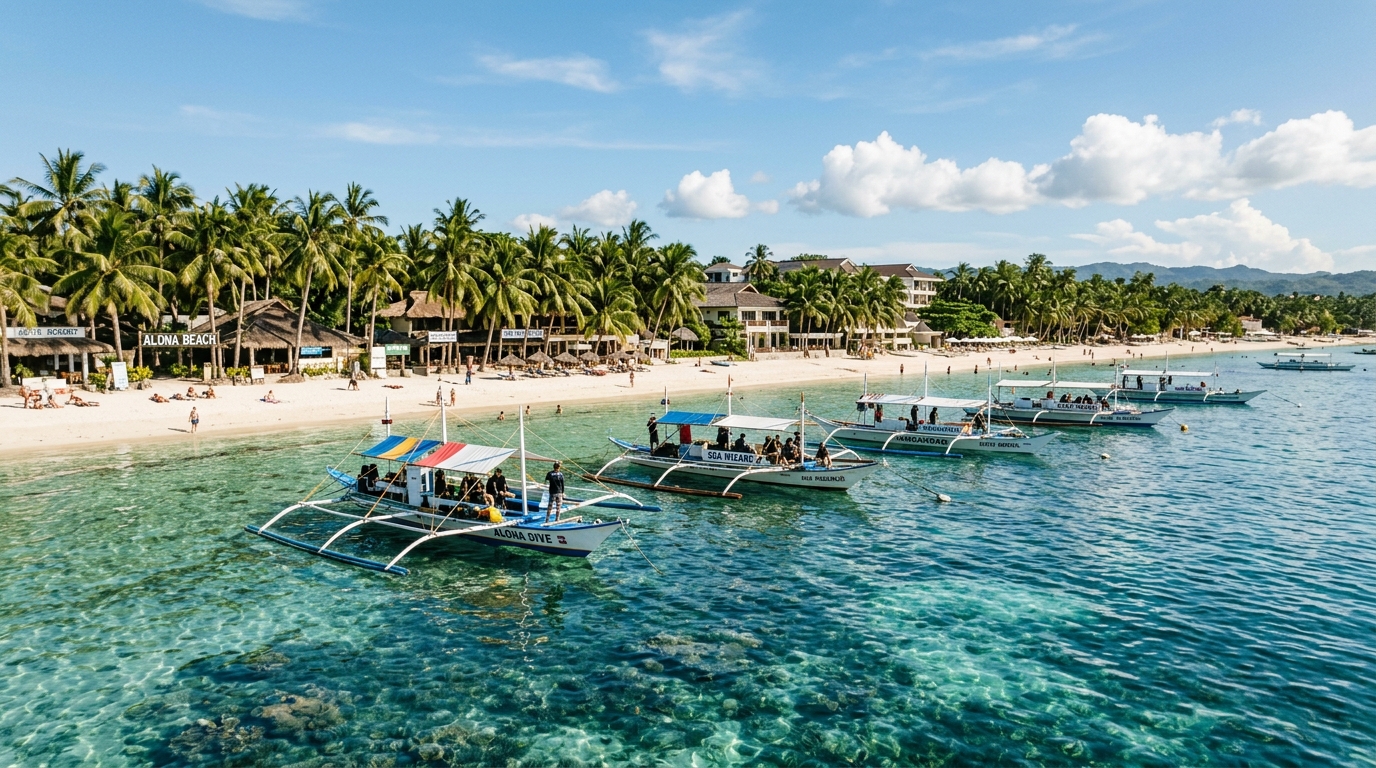
From Alona Beach, Panglao, arrange a banca (outrigger boat) to Balicasag Island. Travel time is approximately 20–30 minutes. Most dive operators based on Alona Beach include Black Forest in their Balicasag day-trip schedules. Day trips typically involve 2 dives on the Balicasag reef system.
Practical Info
- Minimum recommended certification: PADI Open Water (or equivalent)
- Reef top: 5–8 m; slope extends to 40+ m
- Black coral forest: 30–45 m (advanced/deep dive)
- Visibility: typically 15–30 m
- Currents: variable; the site can be dived as a drift dive
- No snorkelling at this site — depth profile is not suitable
- Marine sanctuary rules apply; no coral collection, no anchoring
What to Expect
The shallow reef top (5–8 m) holds smaller reef fish, schools of silver jacks, and sea turtles, usually visible on entry. Along the slope, diversity builds: gorgonians, groupers, barracudas, napoleon (humphead) wrasse, tuna, wrasses, snappers, batfish, triggerfish, surgeonfish, garden eels, Moorish idols, angelfish, trumpetfish, and pufferfish are all recorded here.
Below 30 metres, the branching antipatharian colonies that give the site its name cover the slope wall — the black coral forest itself.
Notes
- This entry (black-forest) is the BPTO tourism-profile record. A second, more detailed source narrative is held in the black-forest-dive entity — review both before publishing; consider merging
- Triggerfish at Black Forest can be aggressive during their nesting season (May–July); divers should be aware
- Balicasag Island is also a marine turtle sanctuary — encounters with green and hawksbill turtles are common on the reef flat
Explore Panglao: Bohol's Busiest Beach and Dive Municipality
More to see in this area
 municipality
Panglao: Bohol's Busiest Beach and Dive Municipality
Panglao is the island municipality behind Alona Beach and Bohol's reef diving, joined to the mainland by two bridges and drawing the largest share of the province's foreign tourist arrivals.
Best: Dec–Apr
More attractions in Panglao: Bohol's Busiest Beach and Dive Municipality
Other things to see nearby
Alona House Reef
The dive site is famous for its beautiful sloped wall covered with many different species of corals. Its sea beds are mostly sandy with a big formation of corals with colorful tropical fishes swimming around.
- Arco Point — The site is also known as "Hole in the Wall" due to a tunnel that begins at a depth of 5 meters and ends in the wall at a depth of 16 meters. The depth differs a couple of meters depending on the tide.
- Balicasag Marine Sanctuary — Balicasag was designated a marine protected area in 1985, with a dedicated sanctuary zone on the island's western side.