
Type: Nature
Overview
Arco Point — also known as “Hole in the Wall” — is a dive site off Panglao Island classified by the Bohol Provincial Tourism Office under Nature / Dive Site. The site is named for the Spanish word for arch (arco): divers encounter a vaulted passage in the reef wall during the dive. A tunnel feature begins at 5 metres depth and exits the wall at approximately 16 metres, with the exact depth varying by 1–2 metres depending on tidal state.
The reef walls terminate at 20 metres, transitioning onto a sandy slope that carries a covering of black sun corals (Tubastraea micranthus and related species). The site description from the BPTO notes it is accessible to divers regardless of experience or certification level — consistent with its general classification as a beginner-to-intermediate site in other source materials.
This entry overlaps with the arco-point-dive-site entity, which draws on a separate scraped source with additional marine species and dive profile data. Together they confirm a wall/slope profile, tunnel feature, accessible difficulty, and black sun coral sandy bottom at 20 m.
Location
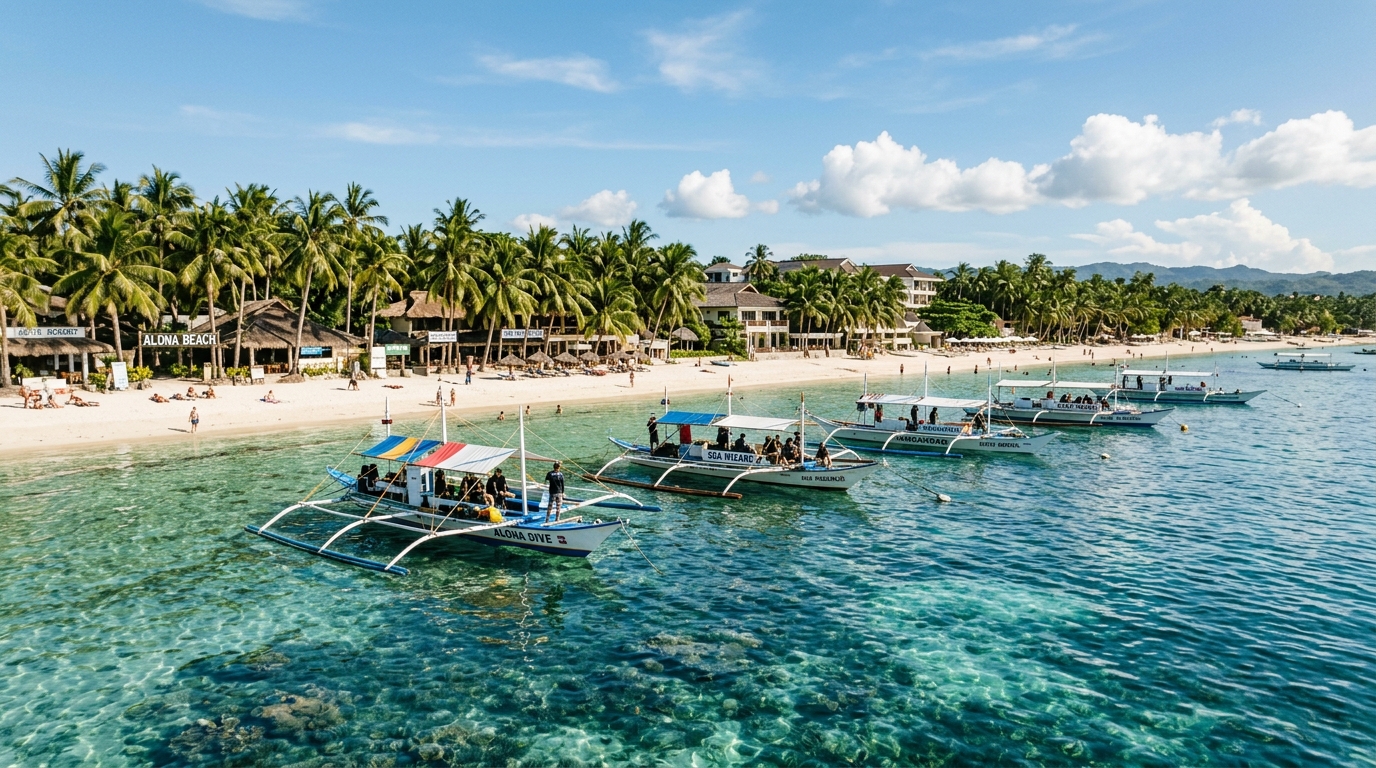
Off the southwestern coast of Panglao Island, Panglao municipality. The dive site is serviced by banca boats from Alona Beach (Barangay Tawala). The site is within the same dive area as Alona House Reef and other Panglao dive sites.
Getting There
From Tagbilaran City, reach Alona Beach by tricycle or jeepney (approximately 30–40 minutes). Dive boats from Alona Beach to Arco Point take approximately 10–20 minutes. Access is by boat only — no shore entry. Book through any Alona Beach dive shop.
Practical Info
Open to all certification levels per BPTO source; however, the tunnel feature and potential drift current suggest basic dive training is advisable. Dive light recommended for the tunnel section. Book through a licensed dive operator from Alona Beach. Published 2025–2026 rate cards from Alona-based dive shops range from roughly ₱1,800 per single boat dive (gear rental extra, around ₱500/day) up to ₱3,920 at operators bundling a fuller service package, with two-dive packages running roughly ₱3,600–6,720. Most Panglao sites, including Arco Point, also carry a standard local environmental fee of around ₱100 per diver.
What to Expect
The signature feature is the arched tunnel in the reef wall — entry at 5 metres, exit at approximately 16 metres (tide-dependent). Walls descend to 20 metres, then level onto a sandy slope covered with black sun coral formations. The vaulted passage is the main draw; the sun-coral-covered slope beneath it gives the wall section a distinct contrast in texture and colour. The site sits in the same boat rotation as Balicasag Island, on the standard Alona dive-shop circuit.
Notes
Source: Bohol Tourism Profile Eco Dev2025.pdf (BPTO Table 11 — Inventory of Tourist Attractions). Tunnel depths (5 m entry, 16 m exit) and wall-to-sandy-slope transition at 20 m are from BPTO source. Additional dive profile details available in the arco-point-dive-site entity sourced separately from scraped HTML. Coordinates are approximate for Arco Point, southwestern Panglao Island. [FACT NEEDED: GPS mooring buoy coordinates — not resolved by research.]
Mooring buoy coordinates (2026-07-28 fresh-angle attempt): No specific mooring-buoy GPS reading was found. This round checked, beyond the plain-English “GPS mooring buoy coordinates” search that produced the original null result: (1) dive-operator pages directly — Alona Divers and PADI dive site listing, both of which publish only a general site coordinate (not a buoy-specific one) and no two of the sources agree on the same figure; (2) a government/NGO-records angle for official mooring-buoy installations — searches for CRMP/BFAR/DENR-CENRO Bohol buoy-installation records turned up only general program references (e.g. a CRMP site-coordinator name tied to DENR-CENRO Tagbilaran) with no coordinate data; (3) a Filipino-language search (“pantalan,” “boya,” “diving Panglao Bohol”) which surfaced no local-language source with buoy coordinates, only the same English dive-shop pages plus a Facebook dive video with no location data in the description. No credible source publishes a mooring-buoy-specific coordinate for this site; leaving the tag in place.
- Our SCUBA diving rates, fare and fun dive prices, accessed 2026-07-17.
- Scuba diving and PADI courses Prices — Tropical Divers Alona, accessed 2026-07-17.
Explore Panglao: Bohol's Busiest Beach and Dive Municipality
More to see in this area
 municipality
Panglao: Bohol's Busiest Beach and Dive Municipality
Panglao is the island municipality behind Alona Beach and Bohol's reef diving, joined to the mainland by two bridges and drawing the largest share of the province's foreign tourist arrivals.
Best: Dec–Apr
More attractions in Panglao: Bohol's Busiest Beach and Dive Municipality
Other things to see nearby
Alona House Reef
The dive site is famous for its beautiful sloped wall covered with many different species of corals. Its sea beds are mostly sandy with a big formation of corals with colorful tropical fishes swimming around.
- Balicasag Marine Sanctuary — Balicasag was designated a marine protected area in 1985, with a dedicated sanctuary zone on the island's western side.
- BBC Reef — The dive site right in front of the Bohol Beach Club has a depth of 4 meters to 30 meters. It is a good dive site for both beginners and experience drivers. It is also a beautiful spot for snorkeling.
Multi-stop circuits featuring this spot
Itineraries that stop here